From Petition to Public Record: A Short History of Civic Requests
Petition history shows how shared concerns reached public authority. Trace the shift from handwritten appeals to digital channels and choose a format that leaves a useful record.
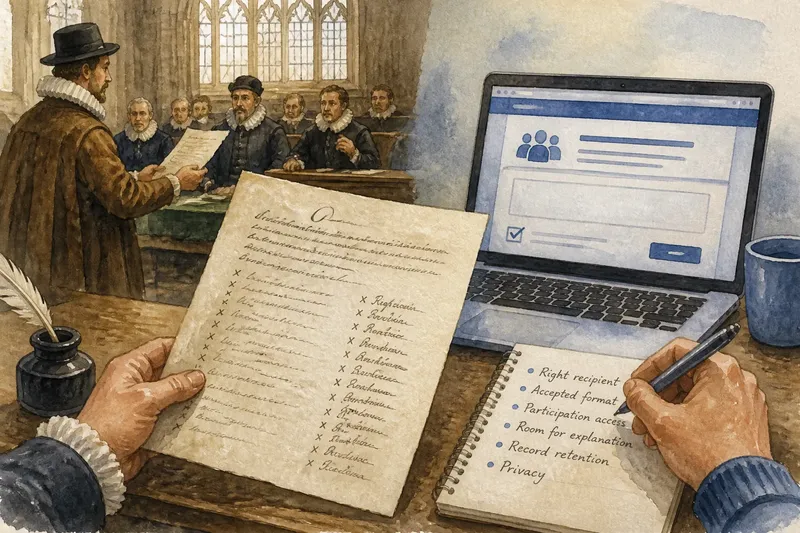
At an English Parliament in the early 1600s, a petitioner could present a written grievance and ask lawmakers to act. The request did not decide the issue, but it placed a claim before an institution. Petition history follows that recurring exchange: people formulate a request, deliver it through an accepted channel, and leave a record that may or may not prompt a response.
Petitions gave people a recognized way to address power
A petition is a request submitted to someone or some institution with authority over the matter. It usually identifies a concern, asks for an action, and names the people or group presenting it. The form matters because it distinguishes a request made to an official body from a complaint shared informally among neighbors.
Petitioning has taken different forms across political systems and periods. In England, petitions to the Crown and Parliament became part of political life well before the modern era; in colonial North America, residents also used petitions to address colonial officials and assemblies. The route and standing of a petitioner depended on the rules and power structures of the place. A petition could seek redress, but it did not make its signers decision-makers.
That distinction remains useful. A petition is not a vote, law, or promise that officials will act. Its civic force is more limited and more specific: it puts a request into a channel where an authority can receive, consider, and answer it.
Paper made collective requests portable and recordable
In the centuries before electronic communication, organizers wrote or dictated petitions, gathered signatures, and carried documents to officials or representative bodies. In Britain, for example, the House of Commons developed procedures for receiving petitions, and Parliament’s historical records preserve petitions from different periods. The surviving documents show that petitioning was not just a private appeal; it could become part of an institution’s paperwork and public business.
A paper sheet connected wording and names in one object. It could be presented at a meeting, passed among potential signers, referred to a committee, or filed. That physical record offered a trace of what was asked, although preservation and access varied. A document kept in an office might later be hard for ordinary readers to locate.
Paper also shaped who could take part. People needed access to the sheet and a way to sign or dictate a name. Organizers, scribes, and intermediaries could help people participate, but they also influenced which concerns reached the page and how those concerns were expressed. A record was therefore evidence of a request and its supporters, not a complete portrait of everyone affected.
Digital channels altered circulation without changing the petition’s purpose
Today, a request may travel on paper, through an agency’s web form, by email, or on a public petition platform. Each channel creates a different path. A formal portal may route a submission to the office responsible for the issue; an online platform can circulate a request among people who are not in one place. Neither format automatically creates a more representative account.
Digital submissions can be stored as form entries, files, or public pages, while paper petitions remain tied to a physical document and its handling. Online forms may impose fields or identity requirements; paper collection may make it harder to gather signatures from people who cannot attend. In either case, organizers should check the recipient’s instructions, access needs, and record-handling practices before deciding how to collect support.
The number of names is only one part of the record. A list may indicate that many people support a request without explaining why. A smaller, clearly worded submission may convey the issue and the requested action more precisely. Readers should be able to identify the ask, who is presenting it, and whether an institution has responded.
Choose a petition channel by its recipient and record
Before collecting names, identify the body that can address the request and find its published submission rules. A petition sent to the wrong office may be difficult to route, while a channel with limited space may not carry enough context. Use these checks to make a practical decision:
- Recipient: Check which office or body has authority over the issue. If the instructions name a responsible recipient, direct the petition there; if no recipient is clear, ask the relevant public office where submissions belong before gathering signatures.
- Accepted format: Check whether the institution requires a portal, form, or other method. If it specifies one, use that channel; if it accepts several, choose the one that participants can access and that preserves the needed record.
- Participation access: Check whether signers can use the channel, considering language, disability access, internet access, and location. If some people would be excluded, add an accessible alternative if the institution permits it; otherwise, ask the recipient how those people can submit support.
- Room for explanation: Check whether the form leaves enough space to state the concern and requested action. If it does, keep the petition concise; if it does not, attach or submit a supporting note when the rules allow it.
- Record retention: Check what confirmation or copy the channel provides. If it supplies a receipt or downloadable copy, save it; if it does not, keep an appropriate copy of the submitted text and ask how to confirm delivery.
- Privacy: Check what personal details the channel asks for and how they may be displayed or handled. If unnecessary personal information is requested, seek clarification before collecting it; if the information is required, explain that requirement to signers before they participate.
It is not worth polishing a petition into a miniature report when the recipient needs a plain request and a clear contact. Extra material can obscure the ask. A short supporting statement is useful when it supplies context the petition itself cannot carry.
What do readers ask about petition history?
Did petitions begin with modern democracy?
No. Petitioning existed in political settings where most people did not have a direct vote on the decisions they wished to influence. Its forms and access varied, but it offered a means to ask authorities for attention or redress.
Did a petition force officials to act?
Usually, the act of submitting a petition did not settle the issue. It created a request for consideration, while the institution retained the authority to accept, reject, refer, or leave it unanswered.
What did paper petitions add to spoken appeals?
A written petition could connect the wording of a request with the names of its supporters and travel to an office or meeting. If retained, it also left a record that could be revisited, though that record might be incomplete or difficult to access.
What is different about an online petition?
An online petition can circulate beyond a single gathering and may store submissions digitally. Its practical value still depends on whether the relevant authority accepts or considers that channel and whether the request remains clear.
A worked choice shows how channel and purpose fit together
Imagine residents of a fictional neighborhood want the city to review a crossing near a school. Their starting inputs are a concise request for a safety review, residents who can sign at a community meeting, and other residents who cannot attend. They check the city’s public instructions and find that the transportation office accepts an online contact form; they also learn that the form has space for a short explanation but does not collect group signatures.
The residents then submit the request through the form, naming the crossing and asking the transportation office to review it. At the meeting, they collect paper signatures on the same wording and include the signed page with a follow-up message if the office’s instructions allow attachments. They save the form confirmation and a copy of the signed page. The resulting record identifies the recipient and request, includes support from people at the meeting, and gives absent residents a route to contribute through the form. The tradeoff is that the office may count or handle the two channels differently, so the organizers describe them as complementary submissions rather than presenting them as one uniform list.
Petition history helps explain why the format endures: it gives people a way to address authority and leaves a trace of what they asked. For a present-day civic request, the most useful channel is the one that reaches the responsible institution, lets affected people participate, and preserves a record clear enough to revisit.